Batch vs Streaming: When Real-Time Data Actually Matters
One processes data in scheduled loads, the other the instant it arrives. Here's the real difference, when each wins, and why streaming isn't always the answer.
In the last article we built a data pipeline and left one big question hanging: does the data move in scheduled loads, or does it flow the instant it’s created? That single choice — batch vs streaming — shapes how the whole pipeline is designed, what it costs, and how hard it is to run.
“Real-time” sounds obviously better, so beginners assume streaming always wins. It doesn’t. Let’s see why.
The one-line difference
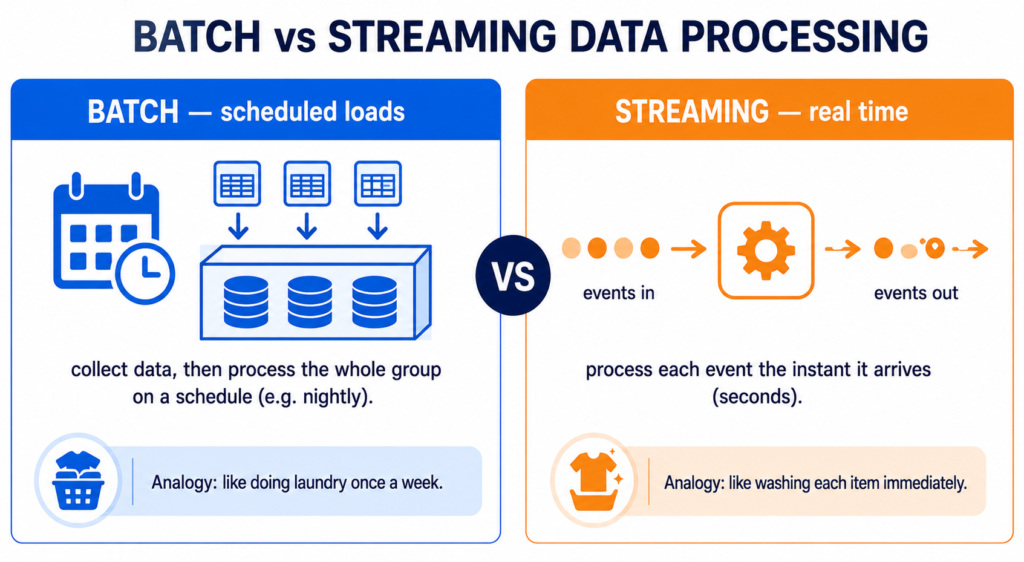
Batch processes data in scheduled groups. Streaming processes data the moment it arrives.
Here’s the analogy that makes it stick: laundry. Batch is doing laundry once a week — you wait until you have a full load, then wash it all at once. Streaming is washing each item of clothing the second you take it off. Both get you clean clothes. They’re wildly different in effort, cost, and how “fresh” the result is.
Batch — process in scheduled loads
Batch processing collects data over a period of time, then processes the whole group at once, on a schedule.
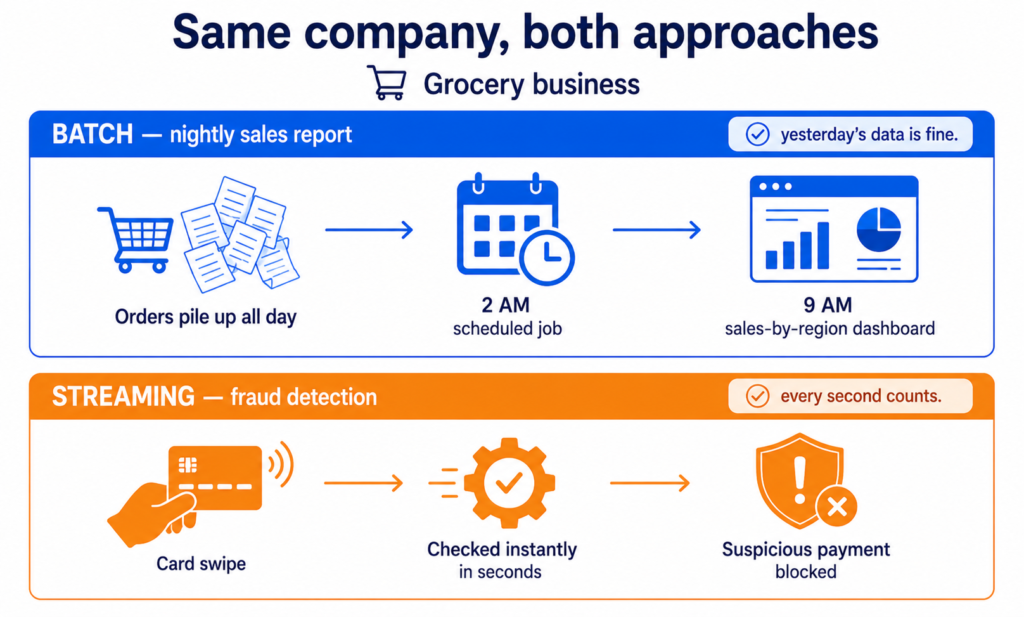
The grocery company’s nightly sales report is pure batch. All day, orders pile up. At 2 AM, one job processes the entire day’s orders together and refreshes the dashboard. Nobody needs yesterday’s sales figure updated second-by-second — once a day is perfectly fine, and doing it in one big load is efficient.
Runs: on a schedule (hourly, nightly, weekly)
Data freshness: as old as the last run (minutes to a day)
Great for: reports, dashboards, billing, payroll, anything not time-critical
Upside: simpler to build, cheaper to run, easier to fix when it breaks
Batch is the workhorse of data engineering. The large majority of pipelines in the real world are batch, because most business questions genuinely don’t need up-to-the-second answers.
Streaming — process the instant it arrives
Streaming (or real-time processing) handles each piece of data the moment it’s created, continuously, with no waiting.
Think of fraud detection on a bank card. If someone’s card is used fraudulently, a report “sometime tomorrow” is useless — the money’s already gone. The system has to react in the seconds between the card swipe and the transaction approval. That only works if each transaction is processed the instant it happens. That’s streaming.
Runs: continuously, always on
Data freshness: seconds or less
Great for: fraud detection, live dashboards, alerts, recommendations, tracking
Downside: harder to build, more expensive, more that can go wrong
Streaming often relies on specialized tools — Apache Kafka is the classic one — that can carry a constant flow of events reliably. We’ll cover Kafka properly later in the series.
Batch vs streaming at a glance
The whole trade-off in one picture — laundry loads versus a running tap.
Batch collects data and processes it in scheduled loads; streaming processes each event as it arrives.
Batch
Streaming
When it runs
On a schedule
Continuously, always on
Data freshness
Minutes to a day old
Seconds or less
Analogy
Laundry once a week
Wash each item immediately
Cost
Lower
Higher
Complexity
Simpler
Harder
Best for
Reports, billing, payroll
Fraud, alerts, live dashboards
Example tool
DataBricks / Airflow-scheduled jobs
Apache Kafka
How to choose: the one question that matters
Forget the hype. Choosing comes down to a single question:
What does it cost the business if this data is a few hours old?
If the answer is “nothing really” → batch. Cheaper, simpler, done.
If the answer is “we lose money, miss fraud, or make a bad decision” → streaming earns its extra cost.
A monthly revenue report? Nobody cares if it’s five hours stale — batch. A live map of delivery drivers, or blocking a stolen credit card? Every second counts — streaming. Most of the time, when you ask that question honestly, the answer is batch.
The mistake beginners make
The classic rookie error is reaching for streaming because it sounds impressive. Real-time systems are genuinely harder: they run 24/7, they’re trickier to debug, they cost more, and a late or out-of-order event can quietly corrupt your results. You take on all that complexity for a “freshness” nobody actually needed.
Hard-won rule: Don’t build streaming because it’s exciting. Build it because the business genuinely loses something when data is stale. Otherwise batch will serve you better and cheaper.
There’s also a sensible middle ground called micro-batch — running small batches very frequently (say, every minute). It feels almost real-time but keeps much of batch’s simplicity. Plenty of “near real-time” dashboards are actually micro-batch under the hood.
Real examples, side by side
The same grocery company uses both, each where it fits:
Same company, both approaches — batch for the nightly report, streaming for instant fraud alerts.
Batch: the nightly sales-by-region report. Runs at 2 AM, once a day. Freshness of “yesterday” is completely fine.
Streaming: flagging a suspicious payment. Must react in seconds, so each transaction is checked the instant it happens.
Notice it’s not either/or for the company — it’s the right tool for each job. That’s how real data platforms work: mostly batch, with streaming reserved for the few things that truly need it.
The takeaway
Batch and streaming are two ways to run a pipeline: batch processes data in scheduled loads, streaming processes it the instant it arrives. Streaming gives you second-by-second freshness but costs more and is harder to build; batch is simpler, cheaper, and correct for the majority of business needs. The right choice isn’t about what sounds modern — it’s about a single honest question: how much does stale data actually cost you? Answer that, and the decision makes itself.
That wraps the foundations of how data moves. Next, we start on the raw material itself — the different types of data you’ll meet, and why structured, semi-structured, and unstructured data each need to be handled differently.
Frequently Asked Questions
What is the difference between batch and streaming processing?
Batch processing collects data over time and processes it in scheduled groups, so results are as fresh as the last run. Streaming processing handles each piece of data the moment it arrives, giving results within seconds. Batch is simpler and cheaper; streaming is fresher but more complex.
Is streaming better than batch?
Not usually. Streaming is only better when data must be acted on immediately, such as fraud detection or live alerts. For most needs — reports, billing, dashboards — batch is simpler, cheaper, and perfectly sufficient. Most real-world pipelines are batch.
When should I use streaming data processing?
Use streaming when stale data has a real cost: detecting fraud, blocking a stolen card, tracking live locations, powering real-time recommendations, or triggering instant alerts. If data being a few hours old causes no harm, batch is the better choice.
What is micro-batch processing?
Micro-batch runs small batches very frequently, such as every minute, to feel almost real-time while keeping much of batch processing’s simplicity. Many “near real-time” dashboards are actually micro-batch, striking a balance between freshness and complexity.
What tools are used for batch and streaming?
Batch pipelines are often built with scheduled jobs run by orchestration tools like Apache Airflow, using SQL and Python. Streaming pipelines typically use specialized tools such as Apache Kafka to carry a continuous flow of events, often paired with stream-processing engines.