What Is SQL and Why Every Data Engineer Must Master It
It's the one language you can't skip. Here's what SQL actually is, why it has outlasted every trend, and what it looks like in practice — explained for total beginners.
Every article in this series has mentioned SQL and quietly moved on. Time to stop dodging it, because if you learn one thing to work with data, this is it. Not Python, not a cloud platform, not the trendy tool of the month — SQL. It has been the backbone of working with data for decades, and it isn’t going anywhere.
The good news: the core idea is genuinely simple. SQL is just a way of asking your data questions.
What is SQL?
SQL (Structured Query Language) is the language you use to ask questions of data stored in tables — to fetch, filter, combine, and summarize it.
Picture a very literal, lightning-fast librarian. You don’t walk into the stacks yourself — you hand over a precise request: “Give me every customer in London who spent over £100 last month, sorted by amount.” Seconds later, they hand you exactly that list. SQL is how you write that request in a way the database understands.
It works on structured data — the neat rows and columns of databases and warehouses. That’s most of the business-critical data in the world, which is a big part of why SQL matters so much.
What SQL actually looks like
Here’s a real question — “what were our top 5 products by revenue last month?” — written in SQL. Don’t worry about memorizing it; just notice how readable it is:
SELECT product_name,SUM(amount) AS total_revenueFROM ordersWHERE order_date >='2026-06-01'GROUP BY product_nameORDER BY total_revenue DESCLIMIT5;
Read it almost like English: select the product name and the sum of amounts, from the orders table, where the order happened since June, group the totals by product, order them highest-first, and give me the top 5. That readability is exactly why SQL has lasted — it’s close to how humans actually ask questions.
The four things SQL does
Ninety percent of everyday SQL is just four kinds of moves:
Select — choose which columns you want to see
Filter — keep only the rows that match a condition (the WHERE)
Join — combine two tables (orders + customers) into one result
Aggregate — summarize with counts, sums, and averages (GROUP BY)
Master those four and you can answer the vast majority of real business questions. Everything else is refinement on top.
Why SQL is worth mastering
Plenty of tools come and go. SQL keeps winning for three stubborn reasons.
1. It’s everywhere
Databases, warehouses, lakehouses, dashboards, even many big-data tools — they all speak SQL. Learn it once and the skill transfers across Snowflake, BigQuery, Databricks, Postgres, and more. Few skills in tech have that kind of range.
2. It’s declarative — you say what, not how
In most programming you spell out every step. In SQL you just describe the result you want, and the database figures out how to get it efficiently. You say “top 5 products by revenue”; the system handles the how. That’s a huge amount of power for very little code.
3. It has survived every trend
SQL is older than most people reading this, and every “SQL is dead” prediction has been wrong. New tools keep adding SQL support because that’s what people know and want. Betting on SQL is one of the safest bets in your whole career.
How SQL fits in — you ask, the database answers
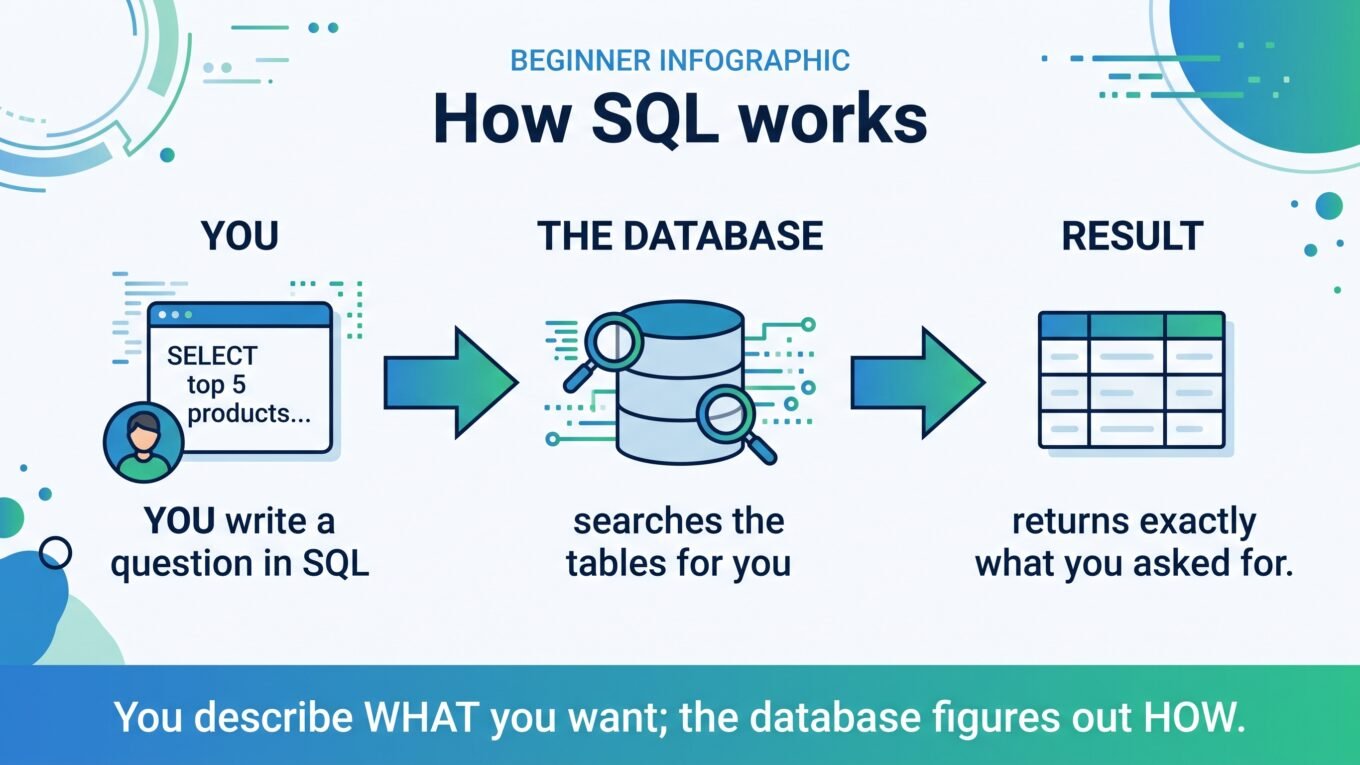
The whole model in one picture: you write a question, the database does the work, you get a table back.
How SQL works — you describe the result you want, and the database returns exactly that.
Why data engineers especially need SQL
Analysts use SQL to answer questions. Data engineers use it for that and to build the machinery itself. Remember the pipeline anatomy? SQL runs right through it:
Transformation: most cleaning and reshaping inside modern warehouses is SQL.
Building tables: engineers write SQL to create the clean, final tables analysts rely on.
Checking data quality: quick SQL checks catch duplicates, nulls, and wrong totals before they reach a dashboard.
For a data engineer, SQL isn’t a reporting tool — it’s a core building material. You’ll use it every single day.
A real question, answered with SQL
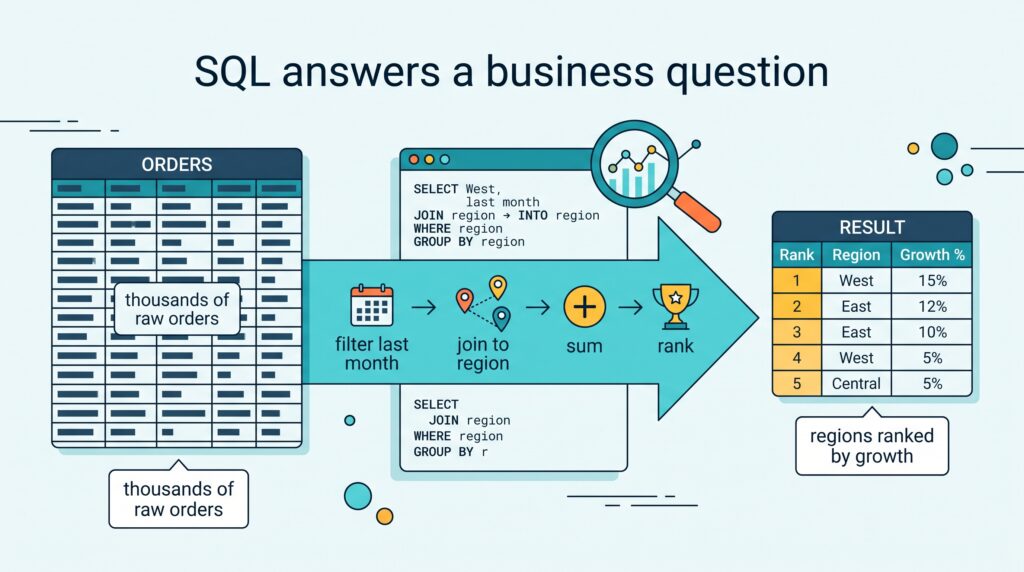
Back to the grocery company. Marketing asks: “Which regions grew fastest last month?” Here’s how SQL turns raw tables into an answer.
SQL turns a raw orders table into a clean, ranked answer to a business question.
The engineer takes the messy orders table, filters to last month, joins each order to its region, sums revenue, and ranks the result — all in a few lines of SQL. What was thousands of raw rows becomes a clean, five-row answer anyone can read.
How to start learning SQL
You don’t need to install anything complicated or “be good at math.” A practical path:
Learn SELECT, WHERE, and ORDER BY first — that alone answers a surprising number of questions.
Add GROUP BY and aggregate functions (COUNT, SUM, AVG).
Then learn JOIN — combining tables is where SQL gets powerful.
Practice on real questions, not abstract exercises. Curiosity beats memorization.
You can be genuinely useful with SQL in weeks, not years. It’s one of the fastest-paying skills to learn in all of tech.
The takeaway
SQL is the language for asking questions of structured data, and it’s the single most important skill in data engineering. It’s readable, it’s declarative (you describe the result and the database does the work), and it’s everywhere — the same skill works across nearly every data tool. For a data engineer it’s not just for reports; it’s how you transform data, build tables, and guard quality, every day. If you’re starting out, start here. Nothing else pays back faster.
Once you’re comfortable asking questions of data, the next thing to understand is how that data is physically stored — because the file format underneath quietly decides how fast and cheap your queries are. Next up: CSV vs JSON vs Parquet vs Avro.
Frequently Asked Questions
What is SQL used for?
SQL is used to ask questions of data stored in tables — selecting columns, filtering rows, combining tables, and summarizing results. Data engineers also use it to clean and transform data, build tables, and check data quality inside databases and warehouses.
Is SQL hard to learn?
No. SQL is one of the easier skills to start with because it reads much like plain English. You can answer real questions after learning just a few commands — SELECT, WHERE, ORDER BY, GROUP BY, and JOIN — and become genuinely useful within weeks.
Do data engineers need to know SQL?
Yes, absolutely. SQL is the single most essential skill for a data engineer. It is used daily to transform data, build the clean tables analysts rely on, and verify data quality. No data engineering role skips it.
What is the difference between SQL and Python for data engineers?
SQL is specialized for querying and transforming structured data in tables, and it’s declarative — you describe the result you want. Python is a general-purpose language used for building pipeline logic, automation, and handling data that doesn’t fit neatly in tables. Data engineers use both, but SQL is the foundation.
Which SQL should I learn first?
Start with standard SQL basics — SELECT, WHERE, ORDER BY, then GROUP BY and JOIN. These work almost identically across systems like PostgreSQL, MySQL, Snowflake, and BigQuery. Once the fundamentals click, small differences between specific databases are easy to pick up.