Every job description for a data engineer says the same vague things. “Build scalable pipelines.” “Ensure data reliability.” “Collaborate with stakeholders.” All true, and all completely useless if you’re trying to picture what the job actually feels like.
So let’s throw out the buzzwords and walk through a real day instead. Meet Priya. She’s a data engineer at a mid-sized online grocery company. Nothing about her day is glamorous — and that’s exactly why it’s worth seeing.
If you haven’t read it yet, this article builds on What Is Data Engineering? A Beginner’s Guide Using a Real Restaurant — the kitchen analogy from that piece shows up here too.
A real day, hour by hour
Here’s the shape of Priya’s Tuesday. We’ll unpack each block below.
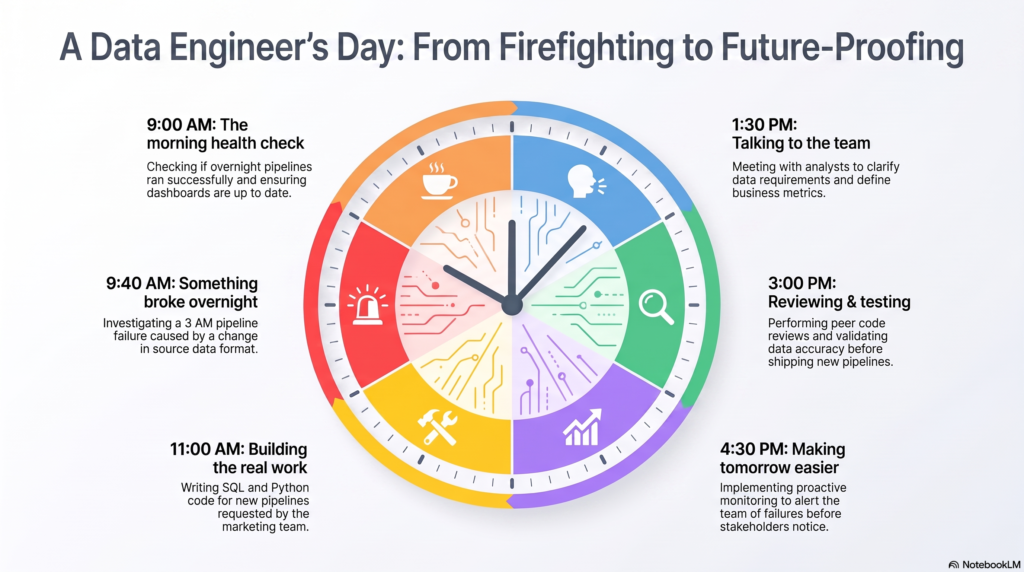
9:00 AM — The morning health check
Priya doesn’t open her laptop and start writing brilliant code. The first thing she does — every single day — is check whether the machine is still running.
Overnight, dozens of automated jobs ran while everyone slept. They pulled yesterday’s orders, refreshed the sales dashboard, updated the inventory tables. Her morning ritual is asking three questions:
- Did everything run? Or did a job fail somewhere at 3 AM?
- Is the data fresh? When someone opens the sales dashboard at 9:05, are they seeing yesterday’s numbers or last week’s?
- Is anything on fire? Any alerts, any weird spikes, any tables that suddenly have zero rows?
Think of it like a chef walking into the kitchen in the morning and checking the fridge before the lunch rush. Are the deliveries in? Is anything spoiled? You find the problems before customers do, not after.
The big idea: A huge part of data engineering isn’t building new things — it’s making sure the existing things are still working and trustworthy.
9:40 AM — Something broke overnight
Today the health check turns up a red mark. The orders pipeline failed at 3:12 AM. The sales dashboard is now showing stale data, and by 10 AM someone in finance is going to notice.
This is the part nobody puts in the job ad, but it’s real and it’s frequent. Priya becomes a detective:
- She reads the error logs to see where it broke.
- She finds the cause: the payment system quietly changed a date format from
MM/DD/YYYYtoYYYY-MM-DD. Nobody told her. The pipeline choked on data it didn’t recognize. - She updates the code to handle the new format, re-runs the failed job, and confirms the dashboard is fresh again.
Total time: about an hour. No new feature was built. But a business-critical report is trustworthy again, and most people never even knew it was broken. That invisibility is the job done well.
Why this happens so often: Data engineers depend on data from systems they don’t control. When an upstream source changes without warning, things downstream break. Handling that gracefully is a core skill.
11:00 AM — Building the real work
Now the fire’s out, Priya gets to the thing she was actually planning to do today: build a new pipeline the marketing team asked for. They want a daily table showing which customers haven’t ordered in 30 days, so they can send a “we miss you” discount.
This is the creative, building part of the job. It looks like:
- Writing SQL to pull and join the right data — orders, customers, last-order dates.
- Writing Python to clean it up and shape it into the exact table marketing needs.
- Scheduling it to run automatically every morning, so no one ever has to do it by hand.
In kitchen terms, she’s writing a new recipe and adding it to the prep line — so that from now on, this dish gets made fresh every day without anyone thinking about it. That’s the essence of a data pipeline: automate the boring, repeatable work so humans don’t have to touch it.
1:30 PM — Talking to the team
Beginners are often surprised how much of data engineering is conversation, not code. After lunch, Priya meets the analysts who requested that “inactive customers” table.
Why the meeting? Because words are slippery. She needs to nail down questions like:
- Does “hasn’t ordered in 30 days” mean 30 calendar days, or 30 business days?
- Does a customer who started an order but abandoned the cart count as active?
- If someone has two accounts, are they one customer or two?
These aren’t technical questions — they’re definition questions. And getting them wrong means the whole table is wrong, no matter how clean the code is. A data engineer who can’t communicate ends up building beautiful pipelines that answer the wrong question.
The underrated skill: Translating fuzzy business language (“active customers”) into precise, unambiguous rules a computer can follow.
3:00 PM — Reviewing and testing
Two things happen here. First, a teammate asks Priya to review his code before it goes live — a second pair of eyes catches mistakes before they reach production. Second, she tests her own morning’s work.
Testing data is its own discipline. It’s not enough that the code runs — the numbers have to be right. So she checks things like:
- Does the row count look sane, or did she accidentally duplicate every customer?
- Do the totals match a number she can verify another way?
- Are there weird nulls or negative values that shouldn’t exist?
A pipeline that runs fast but produces wrong numbers is worse than no pipeline at all — because people will trust the wrong numbers and make bad decisions. This is why good data engineers are a little paranoid, in the best way.
4:30 PM — Making tomorrow easier
Remember the 3 AM failure this morning? Priya ends the day making sure it hurts less next time. She adds monitoring — an automatic alert that will message her the moment that pipeline fails, instead of her discovering it during the morning check.
This is the quiet compounding work of the job: every small improvement to reliability means fewer fires, more sleep, and more time for building. Great data engineers are lazy in the smartest way — they automate their own headaches out of existence.
So what does the job actually break down into?
Priya’s Tuesday wasn’t unusual. Across a typical week, the work sorts into roughly five buckets:
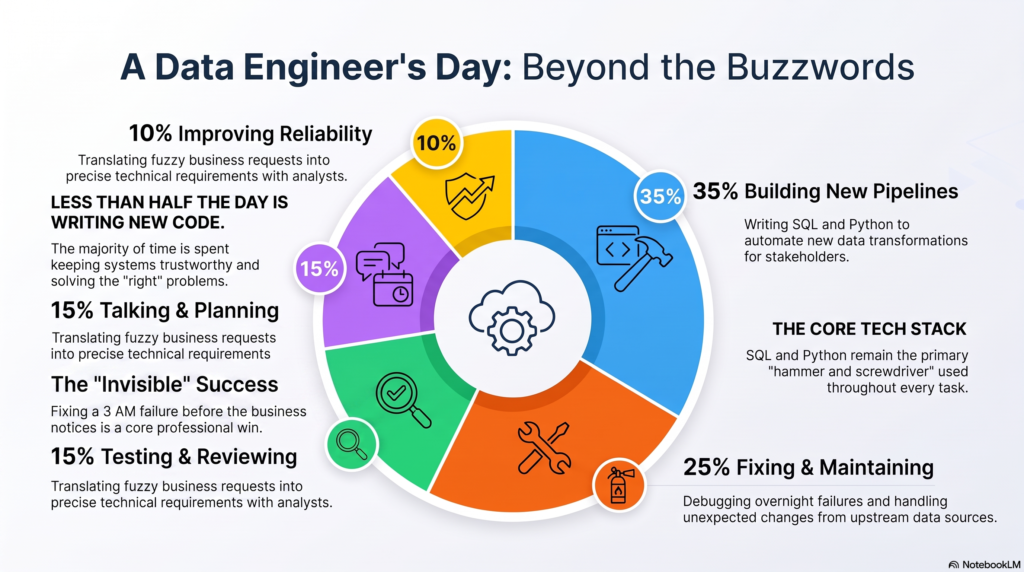
The exact percentages vary by company and seniority, but the shape holds. Notice that less than half the time is writing new code. The rest is keeping things trustworthy and making sure you’re solving the right problem.
What tools does she touch during the day?
You don’t need to know these yet — we’ll cover each in this series — but here’s what was open on Priya’s screen today:
- SQL — to query and join data. Used constantly, all day.
- Python — to clean, transform, and script the pipeline logic.
- A cloud data platform — where the data actually lives and runs (Azure, AWS, or GCP).
- An orchestration tool — the “scheduler” that runs jobs automatically and shows what failed.
- A code repository (Git) — to save changes and collaborate with teammates.
If you’re just starting out, focus on the first two — SQL and Python. They’re the hammer and screwdriver of data engineering. Everything else is a tool you pick up once you know how to build.
The honest takeaway
A data engineer’s day is part builder, part firefighter, part translator, part quality inspector. You write code, yes — but you also chase down mysteries, sit in meetings to pin down what people actually mean, and quietly make systems more reliable so future-you sleeps better.
If that mix sounds satisfying — solving puzzles, building things people rely on, being the person who keeps the numbers honest — you’ll enjoy this work. If you were hoping to write elegant algorithms in silence all day, this probably isn’t it.
Next in the series, we’ll go one level deeper into the systems Priya works with — starting with the two very different worlds that data lives in: OLTP vs OLAP. It sounds intimidating; it isn’t. It’s just the difference between the systems that run a business and the systems that help you understand it.
Frequently Asked Questions
What does a data engineer do on a typical day?
A typical day mixes checking that overnight pipelines ran correctly, fixing anything that broke, building new pipelines with SQL and Python, meeting with analysts to clarify requirements, and testing data to make sure the numbers are correct. Less than half the day is usually spent writing new code.
Do data engineers write code all day?
No. Coding is a big part of the job, but data engineers also spend significant time debugging failures, testing data quality, attending meetings to understand what data people need, and improving reliability through monitoring and documentation.
What skills does a data engineer use daily?
The core daily skills are SQL and Python, plus problem-solving (debugging), communication (clarifying requirements), and attention to detail (making sure data is correct). Familiarity with a cloud platform and a scheduling/orchestration tool is also common.
Is being a data engineer stressful?
It can be, mainly because data engineers are responsible for pipelines that businesses depend on, and things sometimes break at inconvenient times. Good monitoring, testing, and reliable design dramatically reduce that stress by catching problems early and preventing repeat failures.
How is a data engineer different from a software engineer?
A software engineer typically builds applications and features for users. A data engineer builds the systems that move and prepare data so it can be analyzed and trusted. There’s overlap in coding skills, but the data engineer’s focus is on data flow, correctness, and reliability rather than user-facing software.