Picture a restaurant on a Friday night
It’s 8 PM. The dining room is packed. Orders are flying into the kitchen faster than anyone can read them.
Now imagine the kitchen had no system. No one washes the vegetables. Ingredients show up raw, dumped in a pile by the back door. There’s no prep station, no recipes, no plating standards. The chef just grabs whatever’s closest and hopes it works.
That restaurant closes in a week.
A real kitchen works because there’s an invisible system behind the food. Deliveries get checked at the door. Vegetables get washed, chopped, and stored in labeled containers. Recipes turn raw ingredients into consistent dishes. By the time a plate reaches your table, dozens of quiet steps have already happened — steps you never see.
Data engineering is that kitchen system, but for data.
The analysts, the dashboards, the machine learning models, the executive sitting in a meeting asking “how many customers did we lose last month?” — they’re all diners waiting for a finished plate. Data engineers are the people who built the kitchen that makes a trustworthy plate possible.
Hold onto that image. We’ll come back to it the whole way through.
What is data engineering, really?
Here’s the plain definition, then we’ll unpack it:
Data engineering is the practice of building and running the systems that collect raw data, clean it, move it, and organize it — so that other people can actually use it to make decisions.
That’s it. No magic.
Every company today generates a firehose of raw data: website clicks, app events, payments, support tickets, sensor readings, spreadsheets, third-party feeds. On its own, that raw data is like a delivery truck backing up to the kitchen door and dumping crates everywhere. It’s technically valuable, but nobody can cook with it yet.
The data engineer’s job is everything between “raw crates at the back door” and “clean, labeled ingredients ready to cook”:
- Collect the data from wherever it lives (databases, apps, APIs, files).
- Clean it — fix broken values, remove duplicates, handle missing fields.
- Move it reliably from one place to another, on a schedule, without losing anything.
- Organize it into tables and structures that make sense to the people who’ll use it.
- Keep it running so that when someone opens a dashboard on Monday morning, the numbers are actually there and actually correct.
The one-line version: Data engineers turn messy raw data into clean, reliable, ready-to-use data — and keep it flowing.
Why does this role even exist?
Fair question. Twenty years ago, “data engineer” wasn’t really a job title. So why is it one of the most in-demand roles in tech now?
Reason 1: The volume exploded
A small online store today can generate more data in a day than a large company did in a year back in 2005. Every click, scroll, search, and purchase is recorded. That volume broke the old approach of “let the analyst pull it into a spreadsheet.” You can’t fit a firehose into a teacup.
Reason 2: Raw data is almost always messy
Real data is dirty. Dates are stored five different ways. The same customer appears three times with slightly different spellings. A system goes down and sends duplicate records. One team calls it customer_id, another calls it cust_no. Someone typed “N/A” into a column that’s supposed to hold numbers.
If every analyst had to clean all of this themselves, every single time, they’d never actually get to the analysis. So we centralize the cleanup. That’s the kitchen prep station — do the messy work once, do it well, and everyone downstream gets clean ingredients.
Reason 3: Decisions depend on trust
Here’s the scenario that keeps data teams up at night. Five minutes before an executive meeting, someone notices the revenue number on the dashboard looks wrong. Now the whole meeting is spent arguing about whether the data can be trusted instead of making a decision.
Data engineering exists to prevent that moment. When the pipeline is built well, the numbers are correct, consistent, and on time — and nobody has to wonder whether to believe them.
Why the role exists, in one line: Because data got too big, too messy, and too important to leave to chance.
What does the “kitchen” actually look like? (The How)
Let’s walk through how data moves, using the restaurant the whole way. Every data pipeline — no matter how fancy the tools — follows roughly the same four stages.
Stage 1: Ingredients arrive (Data Ingestion)
The delivery truck pulls up. In data terms, this is ingestion — pulling raw data in from its original sources:
- The app database (orders, users)
- Website and app event streams (clicks, page views)
- Third-party tools (payment processor, email platform)
- Plain files people upload (CSVs, spreadsheets)
The engineer’s job here is to reliably grab this data and bring it into one place, on a schedule or in real time. Just like a kitchen accepts deliveries every morning, most pipelines ingest data on a regular cadence.
Stage 2: Wash and chop (Data Cleaning & Transformation)
You don’t serve unwashed vegetables. This is where raw data gets turned into something usable:
- Fix or drop broken records
- Remove duplicates
- Standardize formats (every date looks the same now)
- Combine data from different sources (match the order to the customer to the payment)
- Calculate useful things (total revenue per customer, average delivery time)
This stage is the heart of data engineering. In the industry you’ll hear this called transformation, and it’s the “T” in two terms you’ll see everywhere: ETL (Extract, Transform, Load) and ELT (Extract, Load, Transform). Don’t worry about the difference yet — just know that “transform” means “wash and chop.”
Stage 3: Store it properly (Data Storage)
A good kitchen has a walk-in fridge with labeled shelves, not a random pile. Cleaned data gets stored in an organized home — usually a data warehouse or a data lake — structured into tidy tables so it’s fast and easy to find later.
The label on the shelf matters as much as the ingredient. Well-organized data means an analyst can find what they need in seconds instead of hunting through chaos.
Stage 4: Serve the plate (Serving & Consumption)
Finally, the finished data reaches the people who ordered it:
- Analysts build dashboards and reports
- Data scientists train machine learning models
- Business leaders look at the numbers to make decisions
- Apps use the data to power features (like “customers who bought this also bought…”)
The whole flow at a glance
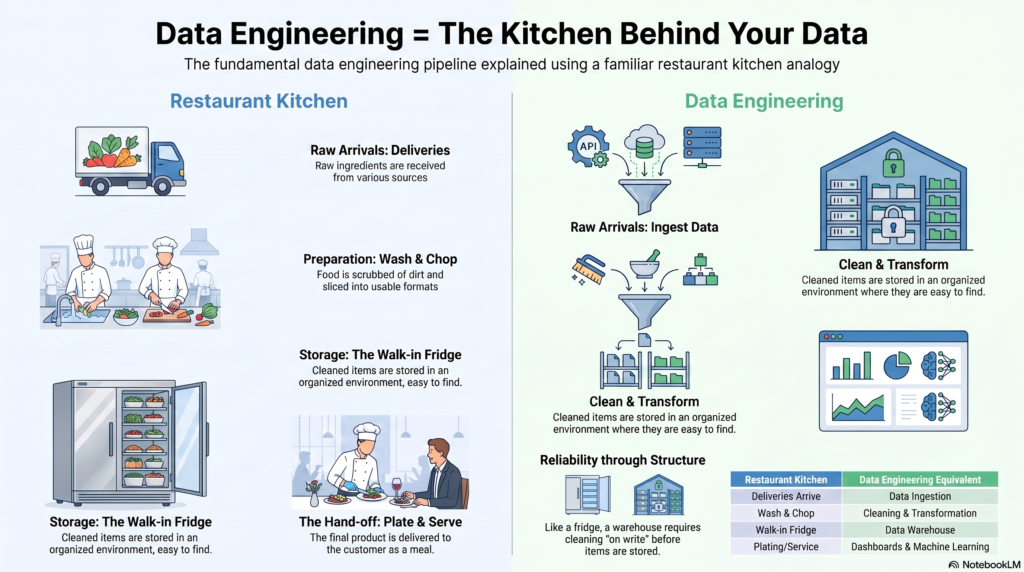
That pipeline — sources to serving — is what a data engineer builds, automates, and keeps alive.
So what does a data engineer actually do day to day?
Stripped of buzzwords, the job looks like this:
- Build pipelines that move data from A to B automatically, so no human has to copy-paste anything.
- Write code (usually Python and SQL) to clean and reshape data.
- Design tables so data is organized in a way that’s fast and makes sense.
- Fix things when they break — a source changes, a file arrives late, a job fails at 2 AM.
- Make sure the data is correct — because a fast pipeline that delivers wrong numbers is worse than useless.
If a chef’s job is “make good food consistently, at scale, without poisoning anyone,” a data engineer’s job is “deliver correct data consistently, at scale, without breaking trust.”
Data engineer vs. data analyst vs. data scientist
Beginners mix these up constantly. The kitchen makes it simple:
| Role | Kitchen equivalent | What they focus on |
|---|---|---|
| Data Engineer | Builds & runs the kitchen | Getting clean, reliable data to flow |
| Data Analyst | Plates and serves dishes | Turning data into reports and insights |
| Data Scientist | Invents new recipes | Building models and predictions from data |
They all depend on each other. But notice: the analyst and scientist can’t do anything until the engineer’s kitchen is running. That’s why data engineering is often called the foundation of the entire data team.
What you’ll want to learn next
You don’t need all of this on day one, but here’s the honest starter list for someone serious about this path:
- SQL — the single most important skill. It’s how you talk to data. Non-negotiable.
- Python — the go-to language for building pipelines and cleaning data.
- Databases and data warehouses — where data lives and how it’s organized.
- How pipelines work — the ingest → transform → store → serve flow you just learned.
- One cloud platform — most data engineering today runs on cloud tools (Azure, AWS, or GCP).
We’ll cover each of these in plain language in the next articles in this series. You don’t need a computer science degree to start. You need curiosity and a willingness to work through things step by step — the same way a line cook learns the kitchen one station at a time.
The takeaway
Data engineering isn’t glamorous, and that’s exactly why it matters. It’s the prep kitchen nobody sees. When it works, dashboards are correct, models get good data, and leaders make confident decisions. When it doesn’t, everything downstream falls apart — quietly at first, then all at once, five minutes before the big meeting.
If you like building systems that other people rely on, if you get satisfaction from turning chaos into order, and if you’d rather be the reason things work than the person in the spotlight — data engineering is a career worth learning.
Next up in this series: what a data engineer actually does all day, hour by hour. We’ll follow a real day, from the morning “did the pipelines run?” check to shipping a new data model.
Frequently Asked Questions
What is data engineering in simple terms?
Data engineering is the work of building systems that collect raw data, clean it, and organize it so other people can use it to make decisions. Think of it as the prep kitchen behind a restaurant: it turns messy raw ingredients (data) into clean, ready-to-use dishes (reliable tables and dashboards).
Do I need to know how to code to become a data engineer?
Yes, but you can learn it. The two core skills are SQL (for working with data) and Python (for building pipelines and cleaning data). You don’t need a computer science degree — you need to be comfortable learning to code step by step.
What’s the difference between a data engineer and a data analyst?
A data engineer builds and runs the systems that deliver clean, reliable data. A data analyst uses that data to build reports and find insights. In kitchen terms: the engineer runs the kitchen; the analyst plates and serves the dishes.
Is data engineering a good career in 2026?
Yes. As companies generate more data than ever, they need people who can make that data usable and trustworthy. Data engineering is consistently one of the most in-demand and well-paid roles in tech, and demand continues to grow.
What tools do data engineers use?
The foundations are SQL and Python, plus a cloud platform (Azure, AWS, or GCP). From there, common tools include data warehouses, data lakes, and pipeline/orchestration tools. You start with the basics and add specialized tools as you grow.