ETL and ELT are the same three words in a different order: Extract, Transform, Load. Swap the last two letters and you’ve flipped one of the biggest shifts in how modern data teams actually work.
It sounds like a tiny distinction. It isn’t. The order decides when you clean your data — and that single choice ripples out into cost, speed, flexibility, and the tools you build on. Let’s make it obvious.
We’ll stay in the kitchen from the first article in this series, because the difference is exactly like two ways of running a restaurant.
First, the three steps
Extract — grab the raw data from wherever it lives (the app, the payment system, files). The delivery truck arrives.
Transform — clean and reshape it: fix errors, remove duplicates, combine sources. Wash and chop the ingredients.
Load — put it into its destination, usually a warehouse or lakehouse. Stock the fridge.
Everyone agrees on Extract first. The fight is about whether you Transform then Load (ETL) or Load then Transform (ELT).
ETL — prep first, then store (the classic way)
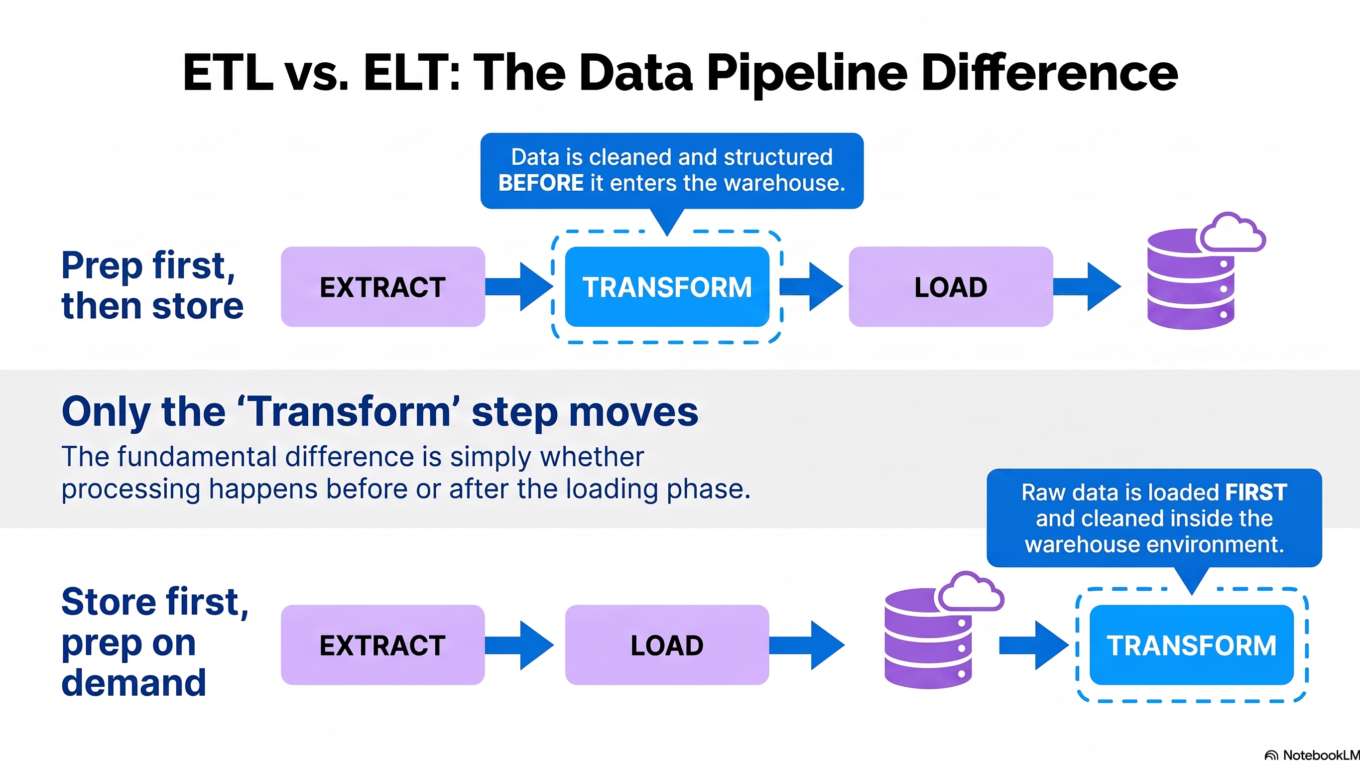
ETL = Extract → Transform → Load. You clean the ingredients before anything goes in the fridge.
Picture a tidy kitchen with a strict rule: nothing enters the walk-in fridge unless it’s already washed, chopped, portioned, and labeled. The delivery arrives, a prep cook cleans everything on a separate table, and only the finished, tidy result goes onto the shelves.
In data terms: you pull the raw data out, transform it on a separate processing server, and load only the clean, final version into the warehouse. The warehouse only ever holds polished data.
Good because: the warehouse stays clean and small; only useful data is stored
Good because: sensitive data can be stripped out before it ever lands (helpful for privacy rules)
Painful because: you must decide how to clean everything up front — change your mind later and you re-run the whole thing
Painful because: that separate transform step can become a slow, expensive bottleneck
ETL was the default for decades, back when storage was expensive and warehouses were the only game in town. You couldn’t afford to hoard raw data, so you cleaned it before paying to store it.
ELT — store first, then prep on demand (the modern way)
ELT = Extract → Load → Transform. You dump everything into the fridge raw, and clean it only when you’re ready to cook.
Now picture a kitchen with an enormous, cheap walk-in fridge. The delivery arrives and goes straight in — raw, unwashed, exactly as it came. When a chef needs carrots for a specific dish, then they grab them and prep just those, right before cooking.
In data terms: you pull raw data and load it straight into a powerful cloud warehouse or lakehouse first. Then you transform it inside that system, whenever and however you need, using its own horsepower.
Good because: you keep the raw data, so you can re-transform it any way you like later
Good because: loading is fast — no bottleneck before data lands
Good because: modern cloud warehouses are powerful enough to transform huge data quickly, in place
Watch out for: you’re storing raw (and messy) data, which costs more and needs governance so it doesn’t become a swamp
This is where lakes and lakehouses come in — they’re cheap enough to hold all that raw data, which is exactly what makes ELT practical.
ETL vs ELT at a glance
Here’s the whole difference in one picture — where the “Transform” step sits is the entire story.
ETL vs ELT — the only real difference is where the Transform step happens.
Side by side
ETL (prep first)
ELT (store first)
Order
Extract → Transform → Load
Extract → Load → Transform
When you clean
Before loading
After loading, on demand
Where you clean
A separate processing server
Inside the warehouse itself
Raw data kept?
No — only clean data stored
Yes — raw is kept
Best with
Traditional warehouses
Cloud warehouses & lakehouses
Flexibility
Lower (fixed up front)
Higher (re-transform anytime)
Storage cost
Lower
Higher
Era it fit
On-premise, expensive storage
Cloud, cheap storage
Why ELT took over
Two things changed, and together they flipped the industry’s default from ETL to ELT.
Storage got cheap. When keeping raw data costs almost nothing, there’s no reason to throw it away by cleaning it first. Keep it all, decide later.
Cloud warehouses got powerful. Tools like Snowflake, BigQuery, and Databricks can crunch enormous datasets right where the data sits. You no longer need a separate server to do the transforming — the warehouse does it, fast.
So the old reason for ETL — “storage is expensive, so clean before you store” — mostly disappeared. ELT gives you the same clean tables at the end, but keeps the raw data and the freedom to reshape it whenever a new question comes up.
The mindset shift: ETL asks “what will we need?” before storing. ELT says “store everything, figure out what we need later.” Cheap cloud storage is what made the second option sane.
So is ETL dead? No.
This is where beginners overcorrect. ELT is the modern default, but ETL is very much alive and still the right choice in real situations:
Privacy and compliance: if you legally must remove sensitive data (like credit card numbers) before it lands anywhere, you transform first. That’s ETL.
Older systems: plenty of companies run traditional warehouses that aren’t built for in-place transformation.
Simple, fixed needs: if the cleaning rules never change and you don’t need raw history, ETL keeps things lean.
Good data engineers don’t pick a side out of fashion. They ask: do we need to keep raw data? Does anything have to be cleaned before it lands? What can our warehouse actually do? The answers point to ETL or ELT — sometimes both, in different pipelines.
The takeaway
ETL and ELT aren’t rival technologies — they’re the same three steps in a different order, and the order encodes a decision about when to clean your data. ETL cleans before storing, which keeps things tidy but rigid. ELT stores raw and cleans on demand, which costs more storage but buys enormous flexibility. Cheap cloud storage and powerful cloud warehouses are why ELT became the modern default — but ETL still wins when privacy, legacy systems, or simplicity call for it.
Notice that both are really just different shapes of the same thing: a data pipeline. That’s what we’ll unpack next — what a data pipeline actually is, end to end, and the pieces every one of them shares.
Frequently Asked Questions
What is the difference between ETL and ELT?
ETL (Extract, Transform, Load) cleans and reshapes data before loading it into a warehouse, so only finished data is stored. ELT (Extract, Load, Transform) loads raw data into the warehouse first and transforms it there, on demand. The difference is when and where the transformation happens.
Is ELT better than ETL?
Not universally. ELT is the modern default because cheap cloud storage and powerful cloud warehouses make it flexible and fast. But ETL is still better when you must remove sensitive data before storing it, when using older warehouses, or when cleaning rules are simple and fixed.
Why did ELT become popular?
Two shifts made ELT practical: storage became very cheap, so keeping raw data no longer wasted money, and cloud warehouses became powerful enough to transform huge datasets in place. Together these removed the main reason ETL existed — cleaning data before paying to store it.
Does ELT need a data lake?
Not strictly, but ELT pairs naturally with data lakes and lakehouses because they cheaply store the raw data that ELT keeps. Modern cloud warehouses can also handle ELT directly. The key requirement is a destination that can store raw data affordably and transform it efficiently.
Which should a beginner learn, ETL or ELT?
Learn the concept behind both, since they share the same three steps. In practice, focus more on ELT because it is the dominant approach in modern cloud data platforms, but understand ETL too — it remains common in privacy-sensitive and legacy environments.